MedIntegrity TA-2.0 Manufacturer & Supplier
TOC Analyzer TA-2.0
Overview
Designed and manufactured by MedIntegrity LLC — the TOC analyzer is built in our own factory, part of a 28-patent product line in pharmaceutical testing equipment.
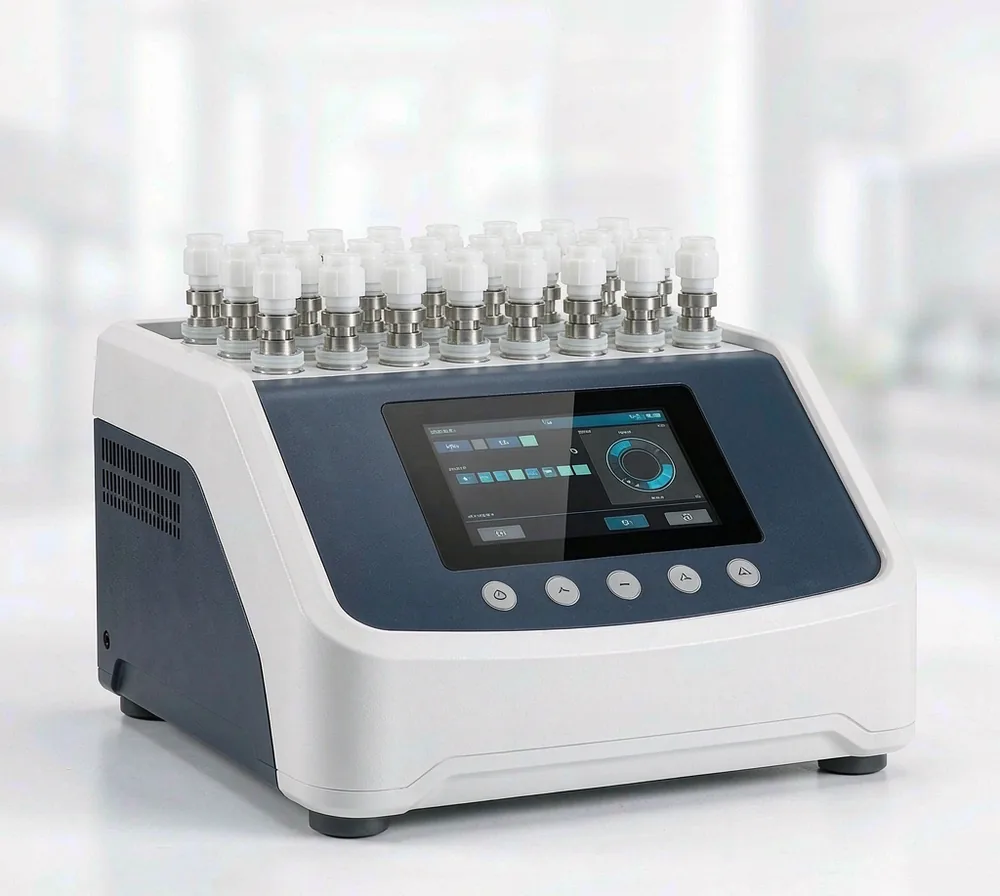
MedIntegrity TOC Analyzer TA-1.0 Establishing a reliable Water Quality Measure & Control StrategyMedIntegrity TOC Analyzer features outstanding sensitivity and can accurately measure low concentration TOC. The analyzer is capable of detecting almost all conditions developed in accordance with GAMP guidelines, and offering full compliance with 21 CFR Part 11 is supported by an extensive qualification documentation package, including guides for Installation and Operational Qualification Performance Qualification(IQ/OQ/PQ Total Organic Carbon (TOC) is often used as a non-specific indicator of water quality. In the natural process of our environment and the man-made processes of industry the ubiquitous nature of carbon provides a screening tool to determine the status of water quality. Customers need a reliable TOC system that can determine contamination from natural occurring compounds, man-made compounds, viruses, bacteria or biological growth. Total Organic Carbon analyzers determine the amount of total carbon in a sample aliquot. Total Organic Carbon is comprised of an Inorganic (TIC) and Organic fraction. The Inorganic fraction consists of the carbonate and bicarbonate compounds. In order to make an accurate determination of the Organic fraction, the analyzer must remove, or quantify, the Inorganic fraction of the sample aliquot.Compared with wet oxidation method and combustion oxidation method, UV oxidation method has been adopted by many manufacturers because of its good characteristics, such as low energy consumption, complete pollution-free, high controllability and complete and rapid reaction. MedIntegrity through in-depth research on organic carbon oxidation and CO₂ detection technology, TOC content measuring will be carried by UV oxidation and conductivity detection technology in this thesis. Using 185nm UV as the oxidation source, which will ensure the efficiency of oxidation reaction; with the development of electronic control system, the influence of electrode polarization effect and capacitance effect on measuring accuracy is reduced by controlling the duty cycle and frequency of the excitation wave of conductivity cell. USP 43 need to measure conductivity is YES USP 43 three-stage determination of purified water is YES
Technical Specifications
| USP 43 need to measure conductivity | YES |
|---|---|
| USP 43 delete chemical tests | YES |
| USP 43 three-stage determination of purified water | YES |
| USP 43 limit of purified water (25°C) | 1.3μS·cm |
| USP 43 three-stage determination of water for injection | YES |
| USP 43 limit of water for injection | 1.3μS·cm |
| JP 17 need to measure conductivity | YES |
| JP 17 delete chemical tests | YES |
| JP 17 three-stage determination of purified water | NO |
| JP 17 limit of water for injection | 1.3μS·cm |
| ChP 2020 need to measure conductivity | YES |
| ChP 2020 delete chemical tests | NO |
| ChP 2020 three-stage determination of purified water | NO |
| ChP 2020 limit of purified water (25°C) | 5.1μS·cm |
| ChP 2020 three-stage determination of water for injection | YES |
| ChP 2020 limit of water for injection | 1.3μS·cm⁻¹ |
| Power Requirements | AC100~260V, 50/60Hz |
| Consumption | 120W |
| Conductivity Detection Range | 0.055μs/cm~8.000μs/cm |
| Measure Range | 0.001mg/L~1.0mg/L(1~1000ppb) |
| Accuracy | ±3%Resolution is 0.001mg/L |
| Response Time | Within 4 mins |
| Measuring Limit | 0.001mg/L |
| Sample Temperature | 1~95°C |
| Environment Temperature | 5~65°C |
| History Function | ≥5Years storage |
| Weight | 8 Kg (Net) |
| Primary Power | AC100~240V 50~60Hz |
| Storage Temperature | 5~50℃Storage Humidity is 25~90% |
| Operating Humidity | 25~60% (Without condensation) |
| Electronic Testing Record | Yes |
| Accuracy | ±3% |
| Response Time | < 4 min |
| Measuring range | 0.001mg/L~1.5mg/L (1ppb - 1500ppb)R |
| esolution | 0.001mg/L |
| Detection Limit | 0.001mg/L |
| Conductivity Detection Range | 0.055µs/cm~8.000µs/cm |
| Sample Temperature | 1~95 ℃ |
| Reproducibility | ≤3% |
| History | ≥3 years |
Specifications subject to change for improvement without notice. For the latest data sheet or technical questions, contact your MedIntegrity representative.
In practice, the TA-2.0 measures 0.001mg/L~1.0mg/L(1~1000ppb), with a 0.001mg/L detection limit, and a full read in Within 4 mins. Short enough for routine water checks, and the electronic record keeps the audit trail clean. Send us your water matrix and we'll confirm the fit.
Technical Documentation
Notes From Our Technical Documentation
Conductivity Determination of Water for Pharmaceutical Use (USP 43, EP 11.0, JP 17 and ChP 2020)
USP 43 need to measure conductivity is YES USP 43 delete chemical tests is YES USP 43 three-stage determination of purified water is YES USP 43 limit of purified water (25°C) is 1.3μS·cm USP 43 three-stage determination of water for injection is YES
Technical Guide
How UV oxidation and conductivity detection measure TOC
Total organic carbon is the amount of carbon in a sample that comes from organic compounds — and in pharmaceutical water, it is the number that tells you the water system is holding its quality. The TA-2.0 measures it by UV oxidation with conductivity detection: the sample is exposed to 185 nm ultraviolet light, which oxidizes the organic carbon to CO2; the inorganic carbon (carbonate and bicarbonate) is removed or quantified so only the organic fraction is counted; and the change in the water's conductivity as the oxidation products appear is what the instrument reads as the TOC result.
Compared with wet oxidation and high-temperature combustion, the UV oxidation route is the one many pharmaceutical water programs have adopted: low energy consumption, no combustion chemistry in the machine, complete and rapid reaction, and a result you can trust at low concentrations. The TA-2.0's detection limit is 0.001 mg/L — the level at which pharmaceutical water programs actually need to see, not a general-purpose water number.
Pharmacopeial water programs, covered
Pharmaceutical water is defined by the pharmacopeias, and the TA-2.0 is aligned to the conductivity determination programs of USP 43, EP 11.0, JP 17 and ChP 2020. For USP 43, the instrument supports the three-stage determination of both purified water and water for injection, with the 25 °C conductivity limit at 1.3 µS/cm — and the chemical tests have been deleted from the USP 43 water program, replaced by conductivity as the screening tool. JP 17 requires conductivity measurement at the same 1.3 µS/cm limit for water for injection; ChP 2020 sets the purified water limit at 5.1 µS/cm (25 °C) and keeps the chemical tests in place.
The conductivity detection range is 0.055 to 8.000 µS/cm, which spans the working window of all three water types. In practice the instrument serves the water system the way the pharmacopeia asks it to: conductivity as the routine screen, TOC as the confirmation, and the record as the evidence.
Speed, range and the data behind the result
The response time is within 4 minutes — fast enough that TOC testing fits into the water system's sampling routine instead of fighting it. The measuring range is 0.001 to 1.5 mg/L (1 to 1500 ppb) with a resolution of 0.001 mg/L and an accuracy of ±3%, and the instrument accepts samples from 1 to 95 °C, so hot loop water can be tested as it comes out of the system rather than cooled first.
The instrument is developed in accordance with GAMP guidelines with full 21 CFR Part 11 compliance support, and the delivery includes the qualification documentation package — guides for IQ, OQ and PQ. History storage is five years or more, and the electronic testing record is part of the instrument, not an add-on. Power is AC 100–240 V at 50–60 Hz (120 W), the net weight is 8 kg, and the environment window is 5 to 65 °C at 25–90% relative humidity without condensation.
Why the 4-minute result fits the water routine
A water system is sampled on a schedule, and the sampling routine only works if the instrument keeps up with it. The TA-2.0's response time of within 4 minutes is the number that makes the routine fit: a set of distribution points, standards and blanks turns over fast enough that the sampling cycle does not back up behind the analysis. And because the instrument accepts samples from 1 to 95 °C, the hot loop water can be tested as it comes out of the system, without a cooling step that adds time and a handling step that adds risk.
The measuring range of 0.001 to 1.5 mg/L with a 0.001 mg/L resolution and ±3% accuracy is the working window the pharmacopeias actually test at — the 1 ppb level of purified water and water for injection, not a general-purpose water number. The 185 nm UV oxidation with conductivity detection is the route many pharmaceutical water programs have adopted for exactly this reason: low energy consumption, no combustion chemistry in the machine, and a complete and rapid reaction.
Frequently Asked Questions
How does the TA-2.0 measure TOC?
UV oxidation with conductivity detection: 185 nm UV oxidizes organic carbon to CO2, inorganic carbon is removed or quantified, and the conductivity change is read as the TOC result.
What is the detection limit?
0.001 mg/L (1 ppb), with a measuring range of 0.001 to 1.5 mg/L, a resolution of 0.001 mg/L and an accuracy of ±3%.
Which water programs does it cover?
USP 43, EP 11.0, JP 17 and ChP 2020 conductivity determination programs for purified water and water for injection, including the three-stage determination where the pharmacopeia defines it.
How fast is a result?
Within 4 minutes per the specification — samples accepted from 1 to 95 °C, so hot loop water can be tested as it comes out of the system.
What about data integrity and qualification?
GAMP-aligned development, 21 CFR Part 11 compliance support, IQ/OQ/PQ documentation in the delivery, history storage of five years or more, and an electronic testing record on the instrument.
Does the TA-2.0 support the USP <43> three-stage determination of purified water?
Yes — per the technical documentation, the TA-2.0 supports the USP <43> three-stage determination of purified water.
Is it suitable for pharmaceutical water systems?
Yes — TOC analysis for pharmaceutical water and process water, from routine monitoring to system qualification.
Which pharmacopeial standards are covered?
USP, JP and ChP water-testing requirements, with model-by-model applicability listed in the specification table above.
Need a quote or technical advice?
Tell us your application — our U.S. team responds with product selection, documentation and pricing.
Request a Quote