MedIntegrity IntegtestV6.5 Manufacturer & Supplier
Integtest V6.5 Filter Integrity Tester
Overview
Designed and manufactured by MedIntegrity LLC — the filter integrity tester is built in our own factory, part of a 28-patent product line in pharmaceutical testing equipment.
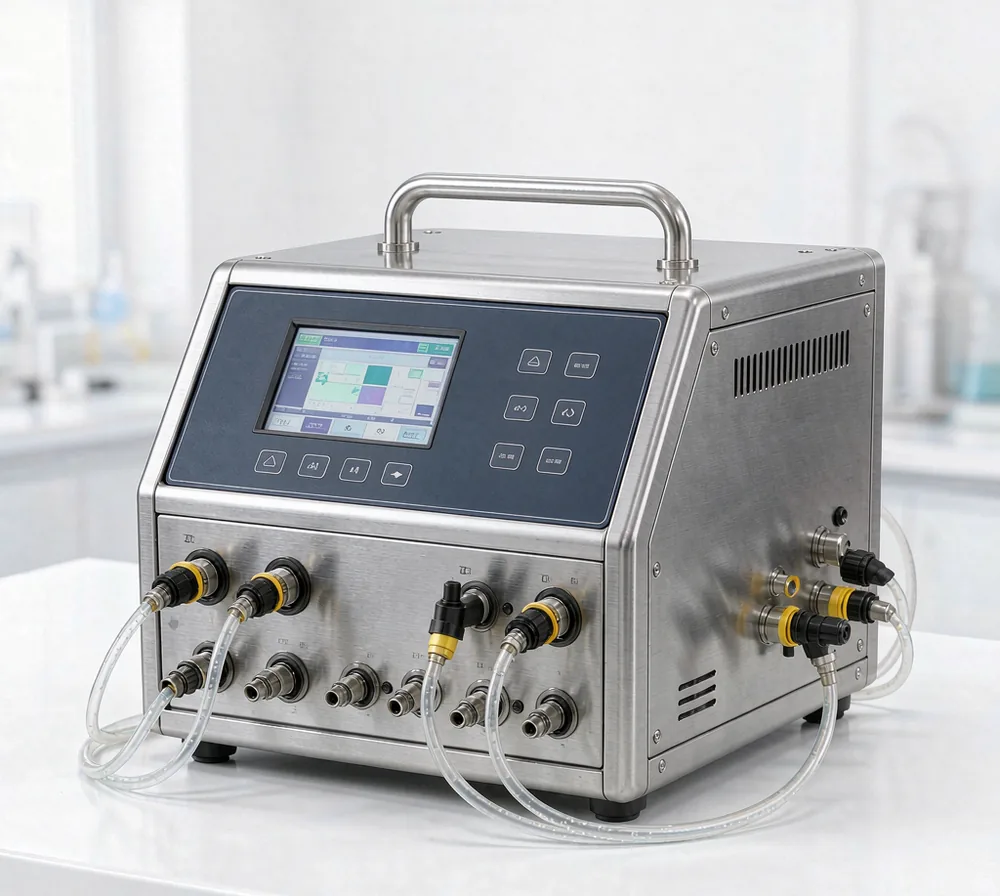
MedIntegrity Filter Integrity Testing Technology Integtest V6.5 Establishing a Contamination Control Strategy The MedIntegrity Integrity measurement Integtest V6.5 systems represent the latest generation of best-in-class integrity test equipment. The instruments have a very sensitive measurement system and are capable of detecting almost all conditions developed in accordance with GAMP guidelines, and offering full compliance with 21 CFR Part 11 is supported by an extensive qualification documentation package, including guides for Installation and Operational Qualification Performance Qualification(IQ/OQ/PQ)MedIntegrity - USANote:Please so kindly understand that the information and specification in this catalogue are subject to change for improvement without notice.If necessary,or any technical question, please contact your MedIntegrity representative. What are the Regulations/Guidance for Sterilizing Filter Testing ·Sterilizing Filter"A filter that, when appropriately validated, will remove all microorganisms from a fluid stream, producing a sterile effluent" Annex 1 has been revised on numerous occasions (1997, 2008, 2022) with each revision accommodating advances in technology,understanding and industry trends The most recent update due for implementation in 2023 contains numerous changes. Many of these aim to address points of ambiguity and adapt language to align with technical and regulatory precedents to achieve greater clarity. The requirement for pre-use, post-sterilization filter integrity testing (PUPSIT) is among the areas that receive adjusted wording.
Technical Specifications
| Operation Condition | Ambient Temperature:+5°C+40°C; Relative Humidity: 10-80% |
|---|---|
| Dimension(mm) | 400(Depth)*260 (Width)*240(Height1)*220(Height2) |
| Historical Record | More than 15000 sets unlimited sets records |
| Display Screen | 7-inch,color touch screen |
| Weight | 8KG |
Specifications subject to change for improvement without notice. For the latest data sheet or technical questions, contact your MedIntegrity representative.
In practice, the IntegtestV6.5 walks through the method set — bubble point to vacuum decay — and stores the results as records your QC file can use directly. If the filter is sterilizing grade, we'll help set the acceptance limit before you run it.
Technical Documentation
Notes From Our Technical Documentation
Regulations & Guidance for Sterilizing Filter Testing
What are the Regulations/Guidance for Sterilizing Filter Testing 2.1 FDA Guidance for Industry-Sterile Drug Products Produced by Aseptic Processing-Current Good Manufacturing Practice September,2004 ·Sterilizing Filter"A filter that, when appropriately validated, will remove all microorganisms from a fluid stream, producing a sterile effluent" 2.2 EU GMP Annex 1 Sterile Medicinal Products Annex 1 has been revised on numerous occasions (1997, 2008, 2022) with each revision accommodating advances in technology,understanding and industry trends The most recent update due for implementation in 2023 contains numerous changes. Many of these aim to address points of ambiguity and adapt language to align with technical and regulatory precedents to achieve greater clarity. The requirement for pre-use, post-sterilization filter integrity testing (PUPSIT) is among the areas that receive adjusted wording. [Heading 4] 2.2.1 Pre-use, post-sterilization integrity testing (EU GMP Annex 1, Sterilizing Grade Filters Used for Aseptic Manufacturing) 2008verified before use and should be confirmed immediately after use by an appropriate method such as a bubble point, diffusive flow or pressure hold test.The time taken to filter a known volume of bulk solution and the pressure difference to be used across the filter should be determined during validation and any significant differences from this during routine manufacturing should be noted and investigated. Results of these checks should be included in the batch record.The integrity of critical gas and air vent filters should be confirmed after use. The integrity of other filters should be confirmed at appropriate intervals. 2022"The integrity of the sterilised filter should be verified by integrity testing before use, to check for damage and loss of integrity caused by the filter preparation prior to use. A sterilising grade filter that is used to sterilise a fluid stream should be subject to a non-destructive integrity test post-use. It is recognised that pre-use post sterilisation integrity testing (PUPSIT) may not always be possible after sterilisation due to process constraints (e.g the filtration of very small volumes of solution).In these cases, an alternative approach may be taken providing that a thorough risk assessment has been performed and compliance is achieved by the implementation of appropriate controls to mitigate any risk of non-sterility..."
Technical Guide
How each method answers a different question
Bubble point is the fastest first check. You pressurize a wetted sterilizing-grade membrane until the largest pore releases a sustained stream of gas, and the pressure at which that happens is your number. It is non-destructive, it is repeatable run after run, and it tells you the state of the largest pore in the membrane — which is exactly what a pre-use check is supposed to tell you.
Diffusive flow is the other half of the picture. It measures the small, steady gas flow through pores too small to bubble, and it is the method that sees the small-pore population and contamination loading. A filter can pass bubble point on Monday and still show a rising diffusive flow by Friday — the kind of drift that a single bubble point number would never surface. Pressure hold watches how well the system holds a set pressure over time: it is the test for a developing leak or a weakening seal, the slow failure modes. Vacuum decay covers the dry side and the gas-side filters in the same loop.
Run together, these methods walk the filter through its whole working life: the pre-use check, the post-sterilization verification, and the periodic in-process checks your validation procedure defines. The instrument does not pick the question for you — your procedure does, and the method set is there to answer it.
Setting acceptance limits you can defend
A bubble point number is only as good as the limit you compare it against. The limit comes from the filter manufacturer's certificate of analysis for that specific lot, interpreted through USP <43>: test pressure and flow limits derived from the rated porosity of the filter. The V6.5 lets you enter that limit, and the result comes out as a pass or a fail — not a number that someone at the end of a shift has to interpret in a hurry.
Validation sets the baseline the same way. You determine, during validation, the time it takes to filter a known volume of bulk solution and the differential pressure across the filter. During routine manufacturing, any significant difference from that baseline gets noted and investigated, and the result goes into the batch record. That is the EU GMP Annex 1 position stated plainly: verify the filter before use, confirm it after, and keep the record with the batch.
A record your audit file can use directly
The V6.5 stores more than 15,000 historical records on board. Every run is captured as a structured record — method, pressure, flow, result, operator, timestamp — in the shape your audit trail expects. Development follows GAMP guidelines with 21 CFR Part 11 support, so the instrument behaves the way your computerized-systems policy expects it to.
The delivery includes the qualification documentation package: guides for installation qualification, operational qualification and performance qualification. In practice that means the instrument goes live inside your validation program, not after it — the paperwork and the hardware arrive as one package, which is how auditors read them.
At 8 kg with a 7-inch color touch screen, it sits on a bench or a mobile cart next to the filter loop it serves. The operating window is +5 to +40 °C at 10–80% relative humidity — a normal laboratory or production room, no special conditions required.
Frequently Asked Questions
Which test methods does the V6.5 run?
Bubble point, diffusive flow, pressure hold and vacuum decay — the method set defined for sterilizing-grade liquid and gas filters under USP <43> and EP 11.0, covering pre-use, post-use and PUPSIT verification.
How are acceptance limits set?
From the filter manufacturer's certificate of analysis for the lot, per USP <43>. We help set the limit before the first run so every result comes out as a clear pass or fail against a documented criterion.
How many results does it store?
More than 15,000 historical records on board, and the qualification package (IQ/OQ/PQ) is part of the delivery, developed in accordance with GAMP guidelines.
Does it support PUPSIT?
Yes. EU GMP Annex 1 (2022 revision) expects a non-destructive integrity test after sterilization where the process allows. The V6.5's method set covers the non-destructive checks that PUPSIT requires.
What are the operating conditions?
+5 to +40 °C at 10–80% relative humidity, 7-inch color touch screen, 8 kg, dimensions 400 × 260 × 240/220 mm (D × W × H1/H2).
Which test methods are available?
Bubble point, diffusive flow, pressure hold and vacuum decay — covering pre-use, post-use and PUPSIT verification for sterilizing-grade liquid filters.
Which pharmacopeial standards does it align with?
USP <43> and EP 11.0 filtration verification, used for pre- and post-sterilization integrity testing of membrane filters.
Can results be documented for audits?
Yes. Results are captured as records that support audit documentation, with 21 CFR Part 11 support across our instruments.
Need a quote or technical advice?
Tell us your application — our U.S. team responds with product selection, documentation and pricing.
Request a Quote