MedIntegrity BGT-200 Manufacturer & Supplier
BGT-200 Single-use Bag Leak Tester
Overview
Designed and manufactured by MedIntegrity LLC — the bag integrity tester is built in our own factory, part of a 28-patent product line in pharmaceutical testing equipment.
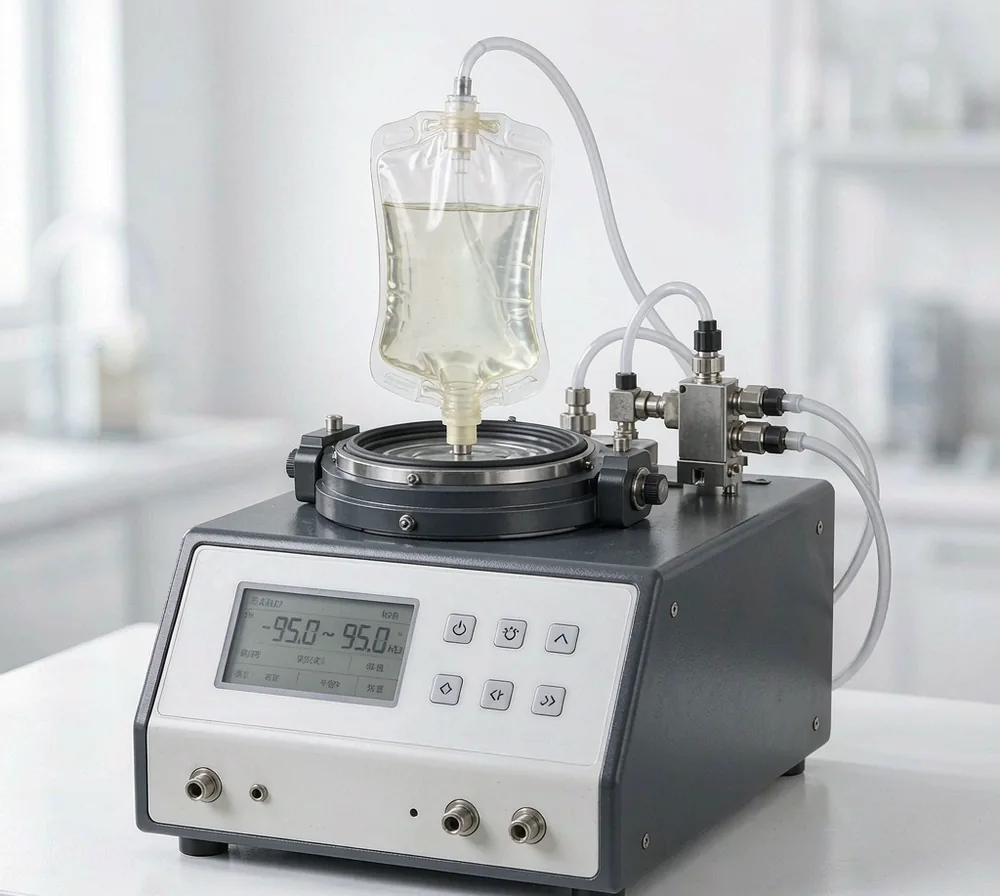
1. Core Technology Overview & Opening Statement MediIntegrity SUS Integrity Testing Technology Ensure the Safety and Quality of Single-Use Bag Integrity Testing MedIntegrity BGT-200 Single-use Bag Integrity Testing system use pressure decay methods to deliver highly accurate results.With the ability to detect leaks of just a few microns,these systems produce quantitative results for long-term trend analysis and data traceability. 2. MedIntegrity Ensuring the Integrity of Single-Use Containers
Technical Specifications
Full specification sheet available on request — contact us.
Specifications subject to change for improvement without notice. For the latest data sheet or technical questions, contact your MedIntegrity representative.
In practice, the BGT-200 uses pressure decay to find leaks in fluid bags and pouches and keeps electronic records for both manufacturing and QC use. Send us your bag format and we'll confirm the fit.
Technical Documentation
Technical Guide
What the BGT-200 tests, and why it matters
Single-use bags are the bulk fluid barrier in biopharmaceutical manufacturing: blending, storage, transfer, fill. A bag with an undetected leak does not fail loudly — it fails quietly, and the product inside pays for it. The MedIntegrity BGT-200 single-use bag leak tester is a pressure decay system that puts a measurable check on that barrier before product goes into the bag.
The method is pressure decay: the bag is connected to a closed test volume, the pressure is set, and the instrument watches the pressure over time. An intact bag holds. A leak, even one of just a few microns, produces a measurable decay, and the system converts that decay into a quantitative result. The result is what you compare against the acceptance limit your validation procedure sets.
Quantitative results, and the trend they support
The BGT-200 produces quantitative results for long-term trend analysis and data traceability. That is the difference between a test that says 'this bag passed' and a program that can show how a bag lot behaved over time, how a new bag design compares to the old one, and what the data looked like the last time a defect was found upstream.
For a bag manufacturer, the trend data supports sealing validation and lot release. For a biopharma site, it supports incoming verification and the critical checks at the stage of fluid filling. Either way, the record is the point: an electronic trail that the auditor can read without asking you to reconstruct it.
How the test fits the bag's working life
Bag integrity is not one test, it is a program across the bag's life. At the manufacturer: raw material inspection, in-process pressure decay testing, sealing validation, packaging and shipping procedures. At the use site: verification at receipt, and the check at the critical stage of fluid filling where the bag is about to carry product. The BGT-200 covers the pressure decay steps of that program, with the quantitative reading as the common language across all of them.
The system is non-destructive in the sense that the test does not damage the bag's barrier — the bag is dispositioned on the result rather than destroyed by the test, which matters when the bag is expensive and the lot is small. And because the result is a number against a documented limit, the routine is repeatable: same method, same limit, same instrument, run after run.
Sealing validation on the manufacturer's side
On the bag manufacturer's side of the program, the BGT-200 serves the steps where the seal is proven before the bag ships: raw material inspection, in-process pressure decay testing during production, sealing validation, and the lot release that clears the bags for shipping. The common language across all of those steps is the quantitative leak reading — the same number at the sealing station and at the release check, which is what makes the validation data comparable to the routine data it was set to govern.
The pressure decay method does not damage the bag's barrier, so the bag is dispositioned on the result rather than destroyed by the test. That matters when the bag is expensive and the lot is small: a failed bag is isolated and investigated, and the record shows why, with the quantitative reading that connects it to the sealing parameters of the run it came from.
At the use site: verification before the fill
On the biopharmaceutical site's side, the BGT-200 covers the two points where bag integrity is a decision, not an assumption: verification at receipt, and the check at the critical stage of fluid filling, where the bag is about to carry product. The handling between the factory and the fill is a window no supplier's record covers, and the test is what closes it with a measurable check before product goes into the bag.
Because the result is a number against an acceptance limit your validation procedure sets, the routine is repeatable run after run — same method, same limit, same instrument. The record is electronic and structured for long-term trend analysis and data traceability, so the bags that carried a campaign are answerable from the record when the question comes, not reconstructed from memory.
One method language across the bag's whole chain
The value of a pressure decay method that both sides of the supply chain can run is that the number stays the same kind of number from the factory floor to the fill room. In the factory, the reading at the sealing station is the one that qualifies the sealing process. At the use site, the reading at receipt is the one that verifies the bags survived the road, and the reading at the critical stage of fluid filling is the one that clears the bag to carry product. When the same method produces all three, the program is one program with one language, and the acceptance limit your validation defines is the limit at every stage.
That is what makes the trend data honest: a lot trend, a supplier comparison, or a new-design evaluation is only meaningful when every point in it was measured the same way. The BGT-200's quantitative reading is that measurement, and the electronic record is what keeps it comparable across stages, across lots and over time. The method is non-destructive, so the bag is dispositioned on the result rather than destroyed by the test, and every disposition — release, hold, investigate — is backed by a record with the operator and the time on it.
What the record is for when the question comes
A bag integrity program earns its keep at two moments: the routine, where every passing bag is quietly cleared to fill, and the exception, where a fail has to be explained. The electronic record on the BGT-200 is built for both. In the routine it is the trail that shows the lot was checked the way the procedure says. In the exception it is the data: the quantitative reading, the operator, the time, and the channel, which is what turns an isolated fail into an investigation you can run and an answer you can document instead of a suspicion you have to manage.
That is the position the program needs to be in when the auditor asks what happened to the bags that carried a campaign: the answer comes from the record, with the same method language the sealing validation and the lot release were written in, and nothing has to be reconstructed from log sheets or memory.
Frequently Asked Questions
What method does the BGT-200 use?
Pressure decay: the bag is connected to a closed test volume, the pressure is set, and the instrument quantifies the rate of pressure change over time.
How small a leak can it detect?
Leaks of just a few microns, per the specification. The detection limit for a specific bag format is established during method development.
What does the result look like?
A quantitative leak reading you compare against an acceptance limit set by your validation procedure — and a record that supports long-term trend analysis and data traceability.
Where is it used?
Bag manufacturing (sealing validation, in-process, lot release) and biopharmaceutical sites (incoming verification and the critical stage of fluid filling).
Is the test destructive?
No — the test does not damage the bag's barrier. The bag is dispositioned on the result rather than destroyed by the test.
Which method does the BGT-200 use?
Pressure-decay leak detection for fluid bags and pouches.
Is it suitable for both manufacturing and QC?
Yes — the BGT family is used for pharmaceutical bag manufacturing and QC, with electronic records.
How do I choose among the BGT models?
Tell us your bag format and testing volume and we'll recommend the right model from the BGT family.
Need a quote or technical advice?
Tell us your application — our U.S. team responds with product selection, documentation and pricing.
Request a Quote